
Podcast
TAAS presents Counterproductive, a podcast about how people live — authors, nomads, scientists, visual artists, and others whose ways of being bend against the ordinary. Each conversation lingers less on résumé and more on rhythm: how a life is made, how meaning is stitched together, how imagination might serve as a compass in chaotic times.
Hosted by Nato Thompson with producer Marisa Mazria Katz, the series drifts between art, politics, and the everyday, searching out voices that point to countless ways of living.
Episode 4: Michel & Alex Auder
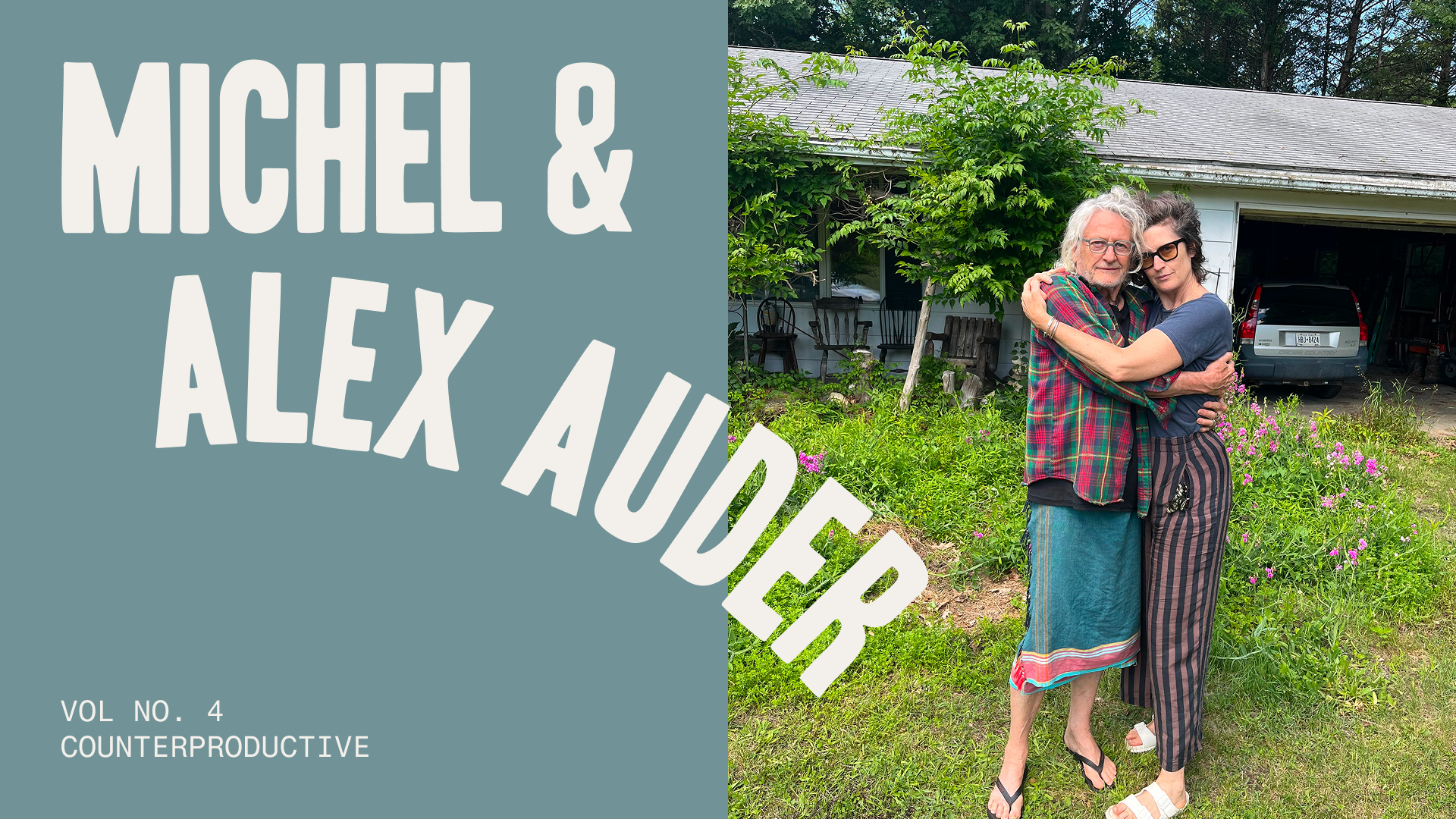
In this episode, artist father and daughter Michel and Alexandra Auder share insights with TAAS founder Nato Thompson into their lives immersed in art, film, and New York's counterculture. They discuss how their experiences shape their creative processes, the mythic status of the Chelsea Hotel, and the intersection of life and art.
Episode 3: Mel Chin
Nato Thompson talks with artist and TAAS instructor Mel Chin about a career built on systems, research, and public-facing impact. They cover Chin’s early life in Houston, his crisis and recovery as a teenager, and the long arc from ceramics and conceptual art into projects that fuse ecology, activism, and policy. They discuss how childhood, illness, and family shaped Chin’s practice; why he moved from studio work into research-driven public projects; and how Revival Field led to later civic interventions like Operation Pay Dirt and Fundred. The conversation also gets into the limits of theory without action, the realities of art-world economics, and why Chin sees the current moment as one that demands reframing and engagement.
Episode 2: Tania Bruguera
In this episode of Counterproductive, explore the life of Tania Bruguera, a renowned performance and social practice artist. In her conversation with TAAS founder, Nato Thompson, she talks about her work, the intersections of art, activism, and political resistance, while also highlighting her experiences in Cuba, Europe, the United States and beyond.
Episode 1: Sasha Stiles
For the first episode of Counterproductive, it felt only right to begin with Sasha Stiles. Sasha first came into our orbit as a student at The Alternative Art School and later returned as an instructor, making her both part of the TAAS community and an example of the kind of artist-thinker the school hopes to support.
A first-generation Kalmyk-American poet, artist, and AI researcher, Stiles has been among the early voices asking what happens when poetry meets machine intelligence. Her work with large language models, including her ongoing AI alter ego technology, has explored how human voice, memory, language, and computation might collide, collaborate, and transform one another. At a moment when AI is reshaping nearly every cultural field, Sasha’s long-standing questions about poetry, authorship, and more-than-human creativity feel especially urgent.